.
SIM cards designed for telemetry (M2M, IoT, IIoT) – why is choosing the right one important?
Telemetry systems M2M (Machine-to-Machine) and IoT (Internet of Things) are now standard in many industries – from energy and heating, through transport and logistics, to manufacturing, building automation and agriculture. Their use is growing steadily and significantly every year. They enable remote monitoring of processes and devices, real-time data reading and rapid or even automated responses to anomalies.
Reliable communication is the foundation of these systems. To ensure this for remote and distributed applications, telecommunications network operators’ services (Mobile Network Operators) are very often utilised, which implies the need to select the appropriate SIM cards. Although it may seem that every SIM card works in a similar way and that the key parameter of the offer is the amount of ‘gigabytes’, in practice the differences between consumer solutions and dedicated telemetry SIM cards are of great significance and have completely different priorities.
Find out:
-
Formalities and penalties – operators define the permissible use of SIM cards
-
Public APN – convenience with limitations and security gaps
-
Dedicated M2M SIM cards – the foundation of telemetry
-
Why is this so important?
-
Standard SIM card vs. Inventia’s offer – telemetria.pl
-
Frequently asked questions (Q&A)
Formalities and sanctions – operators define the permissible use of SIM cards
Many, if not all, telecommunications network operators explicitly prohibit the use of consumer SIM cards in telemetry solutions, monitoring, GSM gateways or other solutions used for automated and mass transmission of data, SMS/MMS in their terms and conditions. Depending on the operator, various penalties may apply for the misuse of SIM cards, e.g. SIM card blocking, charges or fines, or termination of the contract due to the customer’s fault. Therefore, if you decide to use a standard SIM card from a consumer plan for telemetry or IoT solutions, you are more or less knowingly breaching the terms of the contract with your telecoms operator and exposing yourself and your company to the associated consequences.
Furthermore, network traffic is constantly monitored by operators, so there is no point in hoping for a stroke of luck that the card will not be blocked, as this may happen at the most inopportune moment – during a facility failure. Why? Because that is when there is usually an increased volume of data or SMS messages sent, containing information about the facility’s status and alarms.
And, paradoxically, when we need data the most, the SIM card gets blocked and we’re left without data. We’re cut off from the facility and have no idea what’s happening to it.

Public APN – convenience with limitations and security gaps
Standard SIM cards, used daily in smartphones or home routers, utilise a so-called public APN. This is a simple and convenient solution that works well for personal use, but in professional applications it quickly reveals its weaknesses, including:
- Dynamic IP addresses make it difficult to maintain constant access to devices and require the use of additional mechanisms to access the device ‘from the outside’, as well as hindering diagnostics.
- Exposing the device to the public internet leaves the system vulnerable to scanners and attack attempts (e.g. brute force, VNC hijacking), and consequently to unauthorised access; this is also non-compliant with current regulations.
- Lack of management tools makes it difficult to manage multiple cards and devices.
- Lack of an SLA and a dedicated support channel – in practice, such cards do not have a defined service level agreement, which hinders rapid problem-solving, and the customer becomes largely dependent on the operator’s general support channels.
In practice, this means that infrastructure which should operate 24/7 becomes susceptible to disruptions and limitations typical of the mass market, and furthermore does not comply with current regulations such as NIS2 or CRA, as it does not provide adequate security mechanisms, particularly for critical sectors.

Dedicated M2M SIM cards – the foundation of telemetry
M2M operator services have been specifically designed to operate within telemetry systems. Their purpose is to ensure stable and predictable data transmission across distributed devices.
Key features include:
- Static IP addressing – each SIM card, and therefore each device, has a fixed IP address, which significantly facilitates remote access, monitoring, configuration, integration with host systems and diagnostics.
- Private APN – devices communicate within a dedicated address space, isolated from the public internet, where security is significantly higher.
- Secure VPN connection – instead of using an additional SIM card in the ‘head office’, it is possible to establish a VPN tunnel between the customer’s infrastructure (e.g. an edge firewall) and the private APN, within which all SIM cards in the field operate. Traffic is restricted solely to specified SIM cards and the customer’s resources, ensuring the highest level of security and making the solution resilient to failures of the SIM card operator used in the ‘head office’. This also enables effective network segmentation.
- Roaming support – once a data package has been purchased, the SIM cards can operate in different countries and networks, which is crucial, for example, in the transport sector.
- Aggregated traffic billing – data from multiple SIM cards is aggregated, simplifying monitoring and reducing the risk of exceeding limits.
- Continuity of data transmission – once the Data Package has been used up, the SIM cards are not blocked and remain active. The absence of a SIM card block after the Data Package has been used ensures continuity of service and eliminates the risk of sudden interruption to data transmission
- Operator flexibility – the ability to use cards from different networks (T-Mobile, Plus, Orange) depending on coverage and local conditions.
Why is this so important?
Security and stability of communication are the foundation of every telemetry system. In sectors such as district heating, energy and industry, any interruption in data transmission entails real costs and the risk of losing control over the infrastructure. Added to this are current regulations such as NIS2 and CRA, which require critical and important entities to use secure solutions and impose personal liability on management.
At Inventia, the security of our clients’ data has always been treated with the utmost understanding and respect (#security by design, #security by default), which is why we have been providing you with the private APN telemetria.pl service for years, supplying SIM cards dedicated to the telemetry market from the three main telecommunications operators, which also ensures flexibility. The agreements we have with operators include a defined level of service (known as a Service Level Agreement, SLA), thanks to which our service boasts excellent availability and recovery time after a failure. We have recently certified our Information Security Management System in accordance with ISO/IEC 27001 to ensure that the services we provide, based on our solutions and processes, remain of the highest standard.
Thanks to the private APN, static IP addressing and connection encryption via VPN tunnels:
- devices are invisible on the public internet,
- communication is resistant to attempts at unauthorised access from outside,
- the system administrator has full control over traffic,
- a dedicated OT network segment limits the scope of an attack,
- transmission costs are predictable and optimised.
Standard SIM card vs. Inventia’s offer – telemetria.pl
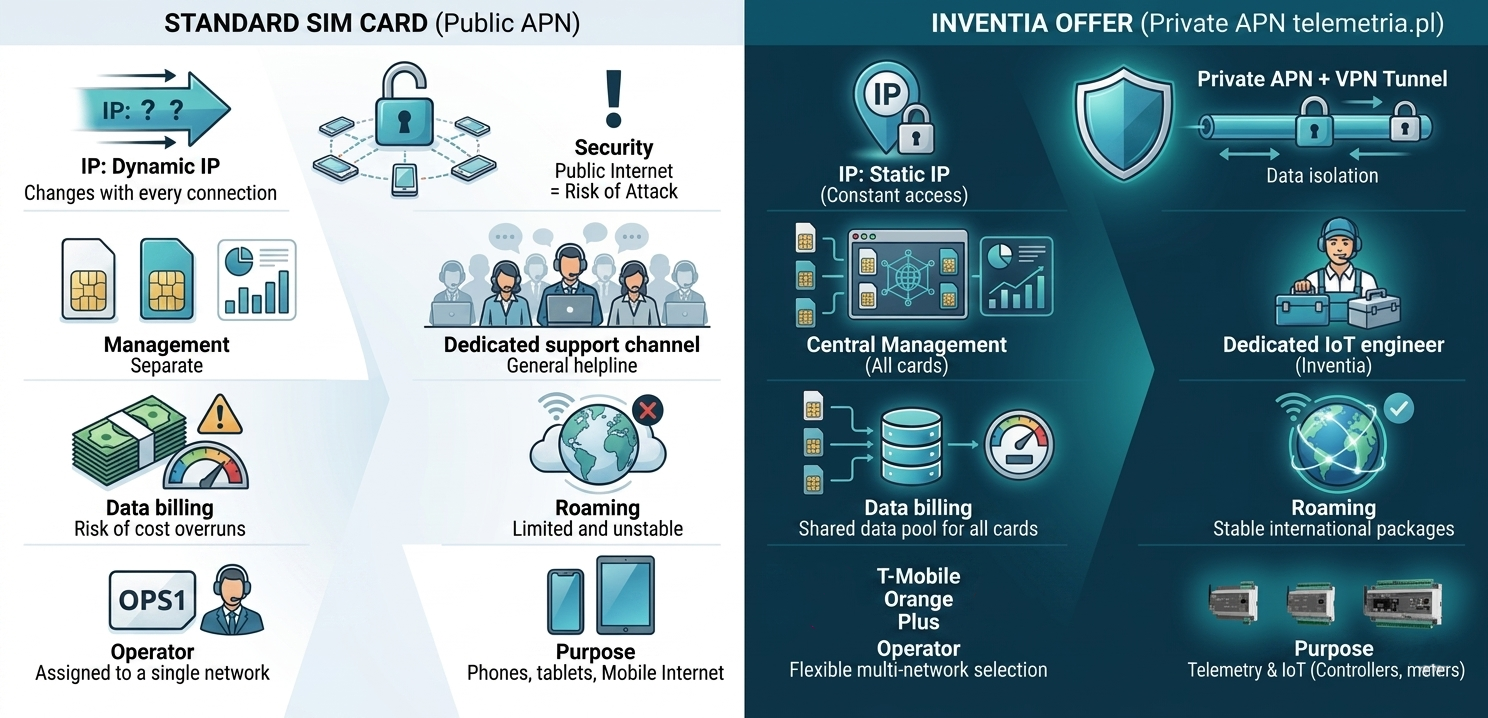
| Area | Standard SIM card (public APN) | Inventia’s offer – Private APN telemetria.pl |
| IP addressing | Dynamic, changes with every connection. | Static IP addressing – easy, remote access to devices. |
| Security | Devices visible on the public internet, risk of attack. | No network segmentation. Private APN + option for an encrypted VPN tunnel between the customer’s network and the APN. Traffic restricted to designated SIM cards only (network segmentation). |
| Management | Each SIM card billed and managed separately. | Centralised management of the SIM card pool, option to use SIM cards from different operators within a single system. |
| Dedicated support channel | General helplines provided by various operators. | Rapid response, assistance with configuration and troubleshooting via Inventia’s dedicated support channels. |
| Data billing | Individual limits, risk of exceeding limits and incurring additional costs. | Aggregated traffic billing, consistent terms for cards from different operators – a shared package for all cards from the pool held with a given operator. |
| Roaming | Limited, often unreliable. | Roaming packages – reliable operation across many countries and networks. |
| Operator | Pre-assigned to a single network. | Flexibility – T-Mobile, Plus, Orange cards; selection based on coverage or customer preference. |
| Intended use | Phones, tablets, mobile internet. | Telemetry and IoT, professional use – operation in meters, controllers, telemetry modules. |
Choosing a data transmission service for your telemetry solution is not a minor technical decision and must not be left to chance, just as price or the number of ‘gigabytes’ cannot be the sole factor determining a sensible choice.
Cutting corners can lead to a significant increase in the costs of operating and securing the solution, and may also be in direct conflict with current standards and regulations.
We therefore recommend that you do not be swayed by marketing slogans or compete on the number of ‘gigabytes’, but instead consider the real value of the service, its security, and the provider’s reliability. The savings resulting from using SIM cards from a standard offering or from an inexperienced provider are only apparent and are usually brutally exposed during the first major failure, following an audit, or when attempting to scale the system.
Choosing the right solution is the factor that determines whether the system will be stable, secure and scalable. M2M cards on a private APN, with static IP addressing and the ability to set up a VPN tunnel, provide exactly what modern telemetry and IoT projects require – reliability, full control over data, and compliance with standards and regulations.
Therefore, when investing in a telemetry system, it is worth ensuring that the foundation is a properly selected SIM card.
Frequently Asked Questions (Q&A)
1. Is a SIM card in the ‘head unit’ always required in a telemetry system?
No. With Inventia systems, a central VPN tunnel can be used between the private APN, where the field SIM cards operate, and the customer’s infrastructure. This means there is no need to place a SIM card in a central device such as the MTX-2050.
2. Which is better: a gateway with an additional SIM card in the central unit or a VPN tunnel?
For smaller installations, it is sufficient to use a gateway that aggregates traffic from field devices with an additional SIM card. For larger installations, we recommend using a VPN tunnel, which also has a positive impact on service availability in the event of a failure with one of the three operators.
3. Is a separate VPN tunnel required for each operator?
No. A single configured VPN tunnel is used to transmit data from the telemetria.pl APN via the three operators.
4. Do all SIM cards have to be from the same operator?
No. Inventia’s offering allows you to mix SIM cards from different operators (T-Mobile, Plus, Orange), which provides the best coverage in every region and ensures stable communication.
5. How does data billing work?
All SIM cards within a given operator can be billed collectively as part of the customer’s total pool of SIM cards, which facilitates cost control and eliminates the risk of individual devices exceeding their limits.
6. Can I use Inventia SIM cards whilst roaming?
Yes. Once the appropriate package has been purchased, the SIM cards can operate in other countries, which is particularly useful in transport and logistics.
7. How is data transmission security ensured?
Thanks to a private APN, traffic between devices is separated from the public internet. If necessary, a VPN tunnel can be established between the customer’s network and the private APN, and data routing can be restricted to selected SIM cards and the customer’s resources only.
Share this article:



Read more articles:
Comprehensive implementation of the Xway platform in the transport and logistics sector
Read the case study on a client profile in nationwide logistics with high security requirements
Inventia is delighted and proud to announce that it has obtained certification for compliance with the ISO/IEC 27001 standard
Read the article and find out more about the Information Security Management System certification